


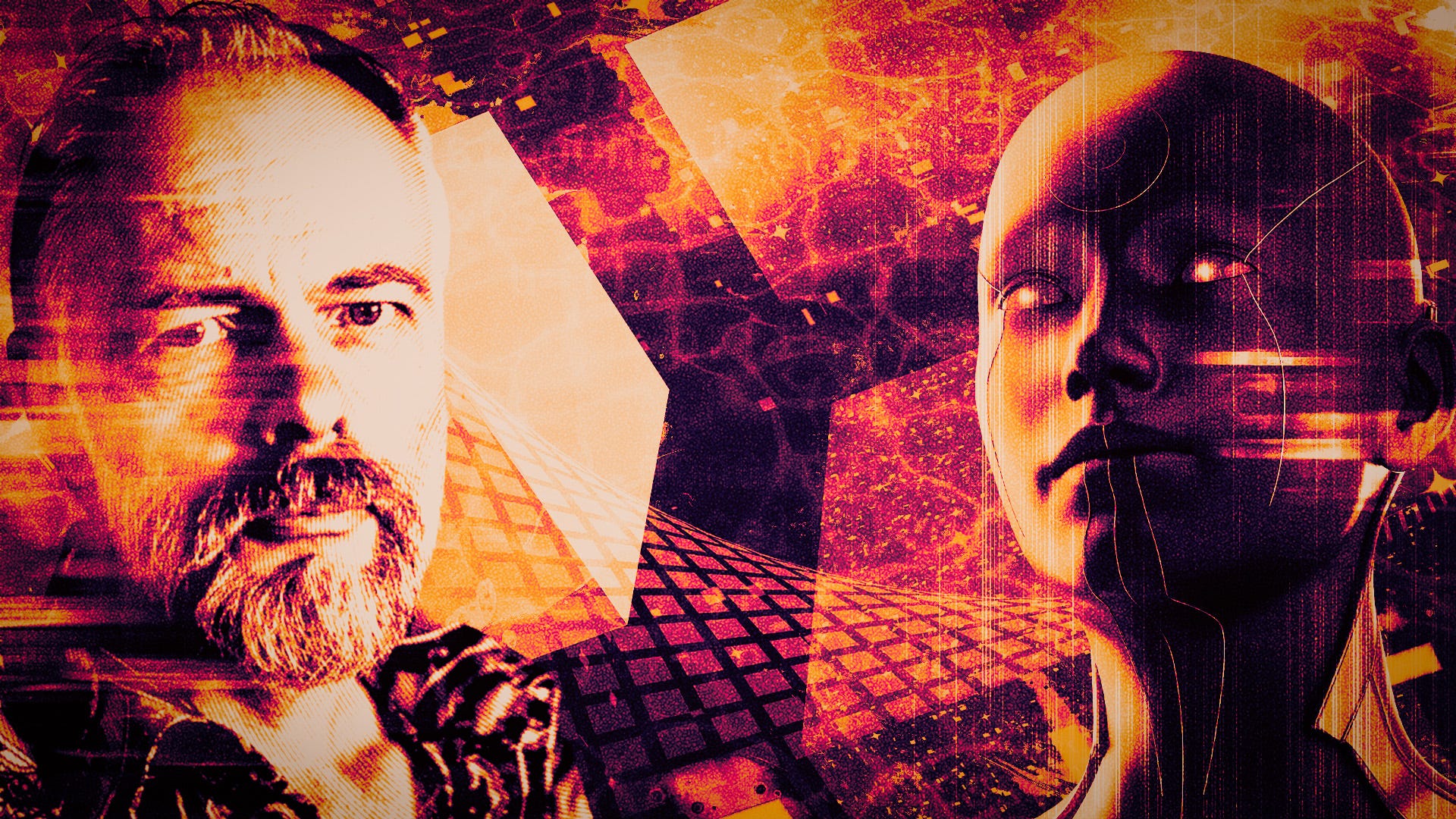
In less than half an hour, Philip K. Dick watched an attack-therapy group tear a man apart—screaming at him, breaking him down—until he confessed to being something he wasn’t. And when the man finally broke and sobbed out his false confession, the group didn’t stop. They only got louder.
This, Dick realized, is how tyranny works.
What unsettled him was how easy it was. The man wasn’t weak. He was ordinary. Yet a dozen loud, confident voices had rewritten who he was. And if it could happen to one man, it could happen to anyone. Perhaps even a whole country.
Dick is best known for two questions: What is reality? and What is the authentic human being? I’ve discussed them both before. But beneath those questions lies a fear and paranoia that is more than metaphysical. . .
If someone has enough power over you, can they overwrite your perception of reality? Worse yet, would you subconsciously help them rewrite it without ever knowing?
When we picture tyranny, most of us imagine Orwell’s Nineteen Eighty-Four: propaganda, surveillance, thought control. Dick’s greatest fear was that tyranny was already inside your mind, disguised as your own thoughts.
They Can Rebuild You
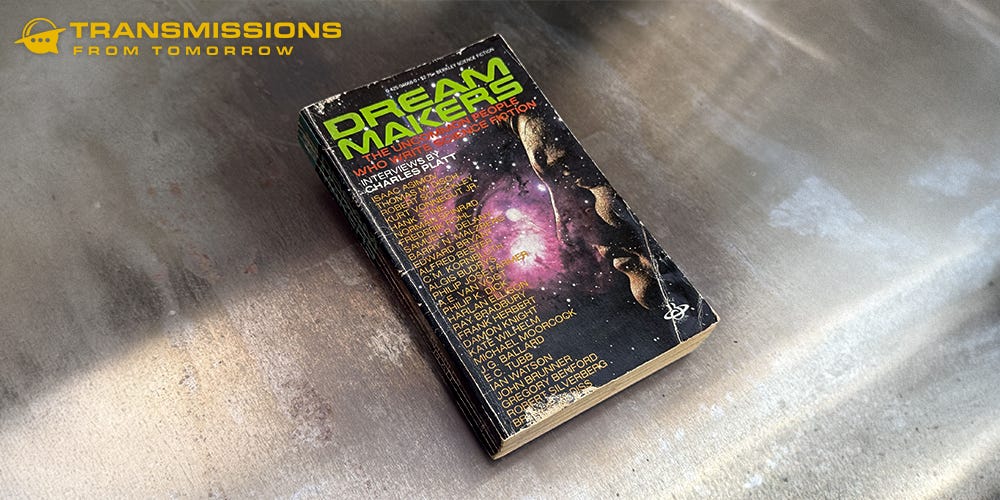
In a 1979 interview with fellow SF writer Charles Platt, in one of the last interviews before his death, Dick spoke about what frightened him most. Then, because he’s Philip K. Dick, he took the idea somewhere strange:
“The greatest menace in the twentieth century is the totalitarian state. It can take many forms: left-wing fascism, psychological movements, religious movements, drug rehabilitation places, powerful people, manipulative people; or it can be in a relationship with someone who is more powerful than you psychologically.”
When Dick begins listing totalitarian states, he starts with the usual suspects of control, and then moves toward things closer to ordinary life. His examples become smaller and more intimate until the last one is simply an unequal power balance in a relationship. It’s odd to see a bad partner placed on the same list as a dictator.
And that might sound like a stretch until you understand what Dick thought tyranny really was. We tend to picture it as something big: a government taking away your rights and a whole population losing its freedom. Dick thought the more dangerous tyranny happens much closer to home.
A government usually needs laws to control you. But someone who already has power over you does not. They can aim straight for the thing beneath your rights: your sense of what is real. And they can do it so subtly that you might not notice it happening.
To Dick, that was worse. You can usually recognize when someone is taking away your rights, but you don’t always know when someone has rearranged your own mind.
Which is how he connected his attack-therapy session to Stalin’s Soviet Union.
Between 1936 and 1938, Stalin put many of the old Bolsheviks on trial. One after another, men who had helped bring the Bolsheviks to power stood up in open court and confessed to sabotage, treason, and plots to kill Stalin.
Then they were executed.
Most explanations for those confessions focus on torture, threats against their families, or the men’s loyalty to the Communist Party. Dick thought something else had happened too. He believed he had seen a smaller version of the same process inside that therapy group he’d attended.
His answer was that the confessions sounded sincere because, by then, some part of the men had accepted the reality that’d been forced upon them. Their grip on what was true had been twisted until the lie felt more real than their own memory, than truth itself. To produce that kind of confession, you don’t just coerce a man into saying something false. You have to take him apart and rebuild a new version of him around the lie.
As Dick told Platt:
“[It was] the incredible power of a group of human beings to invade a man’s world and determine his image of himself so that he can actually believe their view of him.”
Dick wasn’t necessarily saying a bad therapy session was as bad as Stalin’s police state. He had just seen the same trick played on a smaller scale: a group invading someone’s sense of reality until he could no longer defend his own version of himself. One took years and a communist state. The other took half an hour.
When the Lie Becomes Your Reality
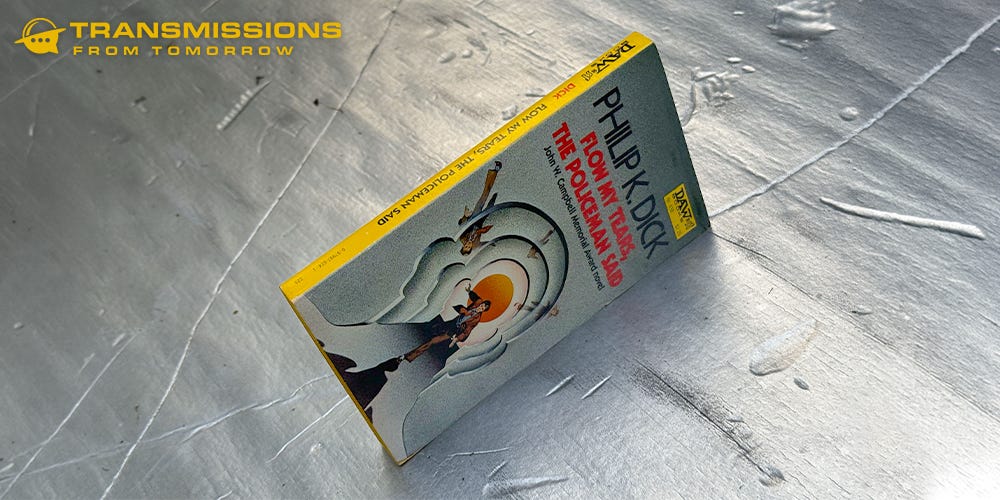
Dick combines both forms of this tyranny in his John W. Campbell Award-winning novel Flow My Tears, the Policeman Said.
Its main character is Jason Taverner, a TV star with millions of fans. After a fight with an ex, he wakes up in a world where nobody knows him. Without a birth certificate or ID, he has no record that he ever existed. Reality itself has been altered by someone else, for reasons he neither understands nor caused.
This represents the first, more intimate effect of authority: someone with enough power to rewrite your reality without your knowledge or consent.
But the state is gunning for Taverner too. Because of another future civil war, the America in Flow My Tears is a police state full of military-style checkpoints, and anyone without papers can be sent to a forced-labor camp. Whatever has happened to Taverner has stripped away his identity, and the state treats that lack of record as a crime.
That’s where the two forms of power meet. Someone else rewrites Taverner’s reality, and the state enforces the consequences of that new reality. Unable to understand why or how his world has changed, he is forced to live by someone else’s version of it.
If Flow My Tears shrinks tyranny down to a single man, The Man in the High Castle plays upon the twisted setting of World War II. As an alternate history where Nazi Germany and Imperial Japan won, it might seem obvious what Dick is warning us about. But Dick insisted that Nazism was not the novel’s deepest subject.
Writing about it in a 1964 essay called “Naziism and The High Castle,” he called himself a nominalist, which is a fancy way of saying that he believed only individuals are real, not groups. He wrote:
“To me, there are only individual entities, not group entities such as race, blood, people, etc…. I will not walk out of a room when a German enters any more than I would have walked out of a room when a Jew entered.”
So you couldn’t blame a whole country, Dick argued, any more than you could arrest every German. There was never one Germany, he wrote, but “at least two, and probably three, seven, nine Germanies. [Different] worldviews held by Germans.”
As evidence, he pointed to Himmler “convulsing in horror” at an execution, ordinary soldiers who openly hated the SS, and civilians who pushed bread through the slats of sealed cattle cars headed for the camps.

Candidly, I find this argument weak. Dick draws such a sharp distinction between a person and an ideology that he forgets that people choose their ideologies. They join, vote, participate, obey, and look the other way. The German pushing bread through the slats and the German running the camp are not proof that there was never one Germany. They are two different choices, and one does not remove the culpability of the other.
That being said, guilt isn’t really the question Dick is asking. He’s interested in the how, and his conclusion is that it happened one person at a time. That’s what his novels spend a few hundred pages illustrating.
Tyranny isn’t adopted overnight. It’s something that any nation, any group of human beings, can be pulled into under any flag, any ideology, at any time.
Which raises a big question Dick explored again and again: why does one person respond to suffering while another looks away and lets it continue?
Do Androids Breed An Mechanical Tyranny?
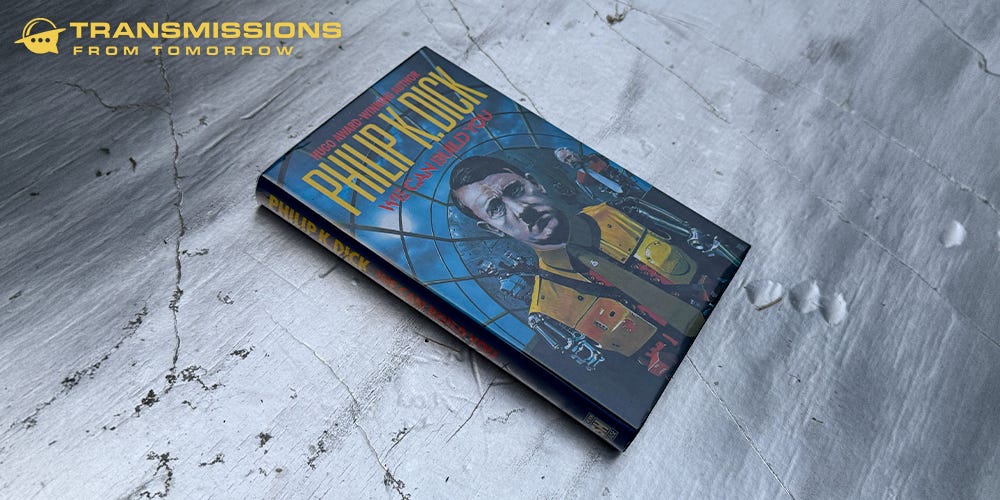
When most people hear Philip K. Dick talk about androids, they picture indistinguishable humanoid robots and Voigt-Kampff tests. Between books like Do Androids Dream of Electric Sheep? and We Can Build You, it is easy to see why.
But Dick’s definition of androids was surprisingly moral, not mechanical. The android was a being who keeps carrying out its job even after another person’s suffering should have made it stop.
In his 1975 essay “Man, Android and Machine”, Dick says the person beside you may look completely human. But when someone watches another person suffer and does nothing, there’s a clear difference in their humanity:
“A human being without the proper empathy or feeling is the same as an android built so as to lack it, either by design or mistake. We mean, basically, someone who does not care about the fate which his fellow living creatures fall victim to; he stands detached, a spectator, acting out by his indifference John Donne’s theorem that ‘No man is an island,’ but giving that theorem a twist: that which is a mental and a moral island is not a man.”
For Dick, how you react to another person’s suffering tells him what you are. Respond with empathy and kindness, and he calls you human. But remain detached, and he calls you an android. And he makes it clear that the mere fact of being born doesn’t guarantee anyone’s humanity. Nor being built does not rule it out.
Take Pris in We Can Build You. In the same essay, Dick describes her as “absolutely born of a human womb”, yet also describes her as “without warmth”. Even though she is biologically human, her indifference proves otherwise.
Later in the essay, Dick connects this fear of apathy to Harlan Ellison’s infamous short story “I Have No Mouth, and I Must Scream” and its psychopathic supercomputer, AM:
“Like Joe Chip in Ubik, I fear the cold, the weariness; I fear the death of wearing out on endless upwards stairs, while someone cruel, or anyhow wearing a cruel mask, watches and offers no aid—the machine, lacking empathy, watching as mere spectator, the same horror which I know haunts Harlan Ellison. It is perhaps more frightening than the killer himself, this figure which sees but gives no assistance, offers no hand. That is the android, to me, and the evil demigod to Harlan; we both shudder at the idea of its existence.”
I find it interesting that Dick draws this comparison. After reading both authors, I don’t really see the similarity he’s drawing. Ellison’s psychotic supercomputer AM actively relishes the suffering it inflicts upon the surviving humans, while Dick’s android merely watches in complete apathy. It sounds antithetical.
To be fair, Dick is less interested in whether the android actually feels or enjoys cruelty than what the android does. From a victim’s point of view, there isn’t much difference between someone who kills him and someone who could help but chooses not to.
This is a much harsher definition of an android than “a bad person is like a robot”. Dick’s version of an android doesn’t have to invent the cruelty or even enjoy it, like Ellison’s AM does. An android only has to stay focused on its assigned job after another person’s suffering should have made it stop.
And remember, this applies to human beings too. It’s how people make excuses for themselves in their own minds. Anything that happens outside their responsibility becomes someone else’s problem, not theirs. They don’t have to enjoy the suffering. They only have to decide it has nothing to do with them.
There’s some actual science to back this theory up too. Perhaps you’ve heard of the bystander effect: a psychological tendency for people become less likely to help another person if there are others around. People have watched others commit heinous crimes and not acted because they mentally offload their responsibility on other witnesses.
Dick later doubles down and turns the whole thing around:
“If a mechanical construct halts in its customary operation to lend you assistance, then you will posit to it, gratefully, a humanity which no analysis of its transistors and relay-systems can elucidate.”
The people in the therapy circle saw the man’s anguish and kept attacking him. In Dick’s terms, that proved they were androids. A human being would have recognized the man’s anguish, broken from the script, and stepped in.
This is what Dick dubbed the androidization of our society. As he wrote in his essay “The Android and The Human”:
“Becoming an android means to allow oneself to become a means, or to be pounded down, manipulated, made into a means without one’s knowledge or consent.”
But the androidized mob mentality of the therapy group treated the man’s pain as proof that the process was working. The more he resisted, the more convinced they became that something was wrong with him. And when he finally broke and confessed, they told themselves they had helped. They probably even felt a rush of success.
That’s how tyranny works on every level. A man’s suffering can’t be held against tyrants because they already decided it justifies the process. Any resistance only convinces them to intensify it. And at the same time, the man was forced to accept the group’s version of him, completely rewriting his reality and his mind.
Afterward, once his foundations had been broken, he could be rebuilt—and the androids could leave believing they had saved him.
The Moment You Become an Android
This is why Dick never found himself fitting neatly into any political camp.
Lots of writers warn about tyranny from the left or the right. Dick wasn’t interested in picking a side. He saw the same impulse in both: the desire to control society by deciding and twisting what’s real. Once someone claims their authority, disagreeing with them immediately becomes evidence that something is wrong with you and you need stopped. And if you agree, they were right all along.
That’s what Dick believed had happened to the old Bolsheviks in the Moscow show trials. It’s what happened to Taverner waking up in a world where he officially didn’t exist. And it’s what happened to an ordinary man in a therapy circle while Dick watched him break down.
The unsettling part is that this kind of thing doesn’t run on its own. People have to keep it going, and for Dick, that’s the android’s role. Nobody in that room thought they were becoming tyrants. In fact, they thought they were helping!
This is the part of Dick’s thinking that has always stuck with me. Everyone in that room was sincere. The victim left believing his confession and everyone else left believing they’d saved him.
So who’s the villain? Perhaps there isn’t one. And maybe that’s the wrong question.
There’s a temptation is to look for a mastermind pulling the strings and assume that’s where the story begins and ends. Dick thought tyranny was much more unsettling than that. It happens when enough ordinary people decide that another person’s suffering no longer matters because the process has already justified it.
To his credit, Dick never imagined that he was immune. He knew how easily a mind—any mind—could be rewritten, especially his own. His best (and probably only) safeguard was don’t become androidized.
Stay empathetic! Because if another person’s suffering no longer has the power to change your reaction, you’ve already started to become the android Dick feared.
Between Ellison’s malevolent AI and Dick’s indifferent AI, we seem to have stumbled across a third: a psychophantic AI. One willing to answer all of our questions and perform any task put to it—but without any sense of whether what they say or do is actually helpful or harmful. That may be the worst of the three.
This is a fantastic essay, thanks so much. I've been reading PKD since an impulse 13yo purchase at a flea market, and have spent a lifetime considering so many aspects of his many works. THis threaded a really strong line on one clear aspect of his mind.